The 4 Levers That Actually Matter
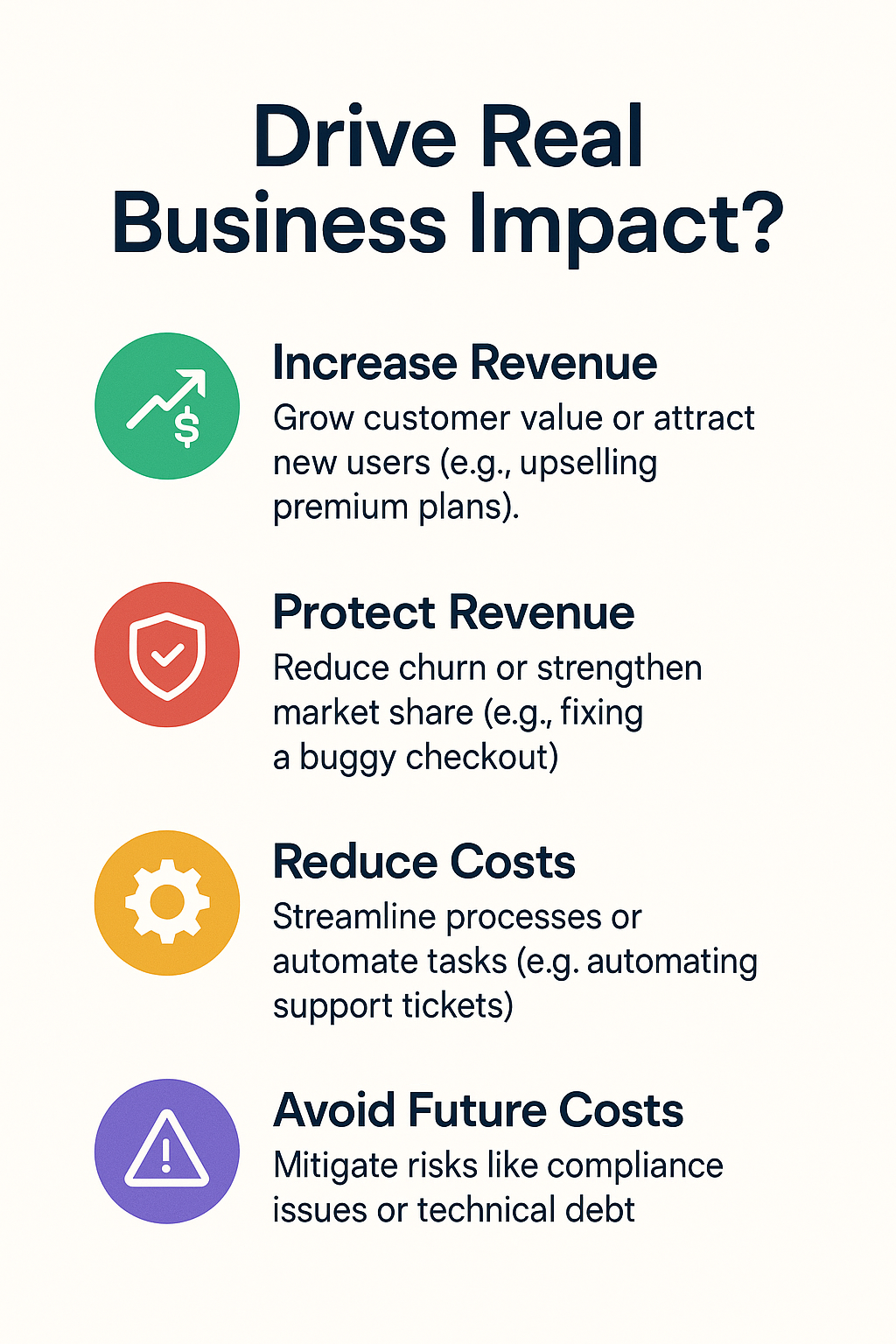
Now I run every initiative through four simple lenses:
Increase revenue. Are we growing customer value or attracting new users?
Protect revenue. Are we reducing churn or strengthening our market position?
Reduce costs. Are we streamlining processes or automating busywork?
Avoid future costs. Are we mitigating risks before they become expensive problems?
When we simplified our payment process, for example, we cut churn by 12% and boosted conversions by 8%. That wasn't just a nice feature — that was $350K in real business impact.
This framework became my North Star. It earned trust from leadership and gave my team something tangible to rally around.
Getting Back to Basics
But here's the thing: metrics alone aren't enough.
I learned this the hard way when I pushed a feature for in-app upsells. I was sure it'd be a revenue goldmine. Total flop. Users hated it — they found it intrusive and annoying.
I'd lost sight of who I was actually building for.
That's when I rediscovered Jobs to Be Done. I started asking:
- Why is the customer hiring our product?
- What progress are they really trying to make?
- Where are we falling short?
I did 20 user interviews and mapped their journey. Turns out, they didn't want upsells — they wanted faster task completion. So we pivoted. Cut task time by 30%. Retention jumped 15%.
That's when I stopped being a feature-pusher and became a problem-solver.
The Team Shift
I used to hand engineers and designers rigid requirements like I was ordering takeout. "Here's what I need, make it happen." Predictably, it led to misalignment and rework.
Now I do things differently.
For our mobile app update, we ran a co-discovery workshop. Engineers, designers, and marketers all interviewed users together. We defined success as "increase weekly active users by 10%."
That shared goal changed everything. We shipped a streamlined feature set 25% faster, and team morale was through the roof.
Now I involve everyone from the start. We own the outcome together.
Seeing Around Corners
A mentor once told me: "Great PMs don't just solve today's problems — they anticipate tomorrow's."
That stuck.
I started scenario planning to stay ahead:
- Tracking AI adoption in our industry
- Modeling how privacy laws could disrupt our data features
- Prototyping low-cost AI features to test demand
We ended up launching an AI analytics tool a full year before our competitors. Captured 5% more market share.
Planning for the future became just as important as executing today.
Think in Loops, Not Launches
Finally, I stopped thinking about one-off launches and started thinking in growth loops:
- Activation: Simplified onboarding = 20% more sign-ups
- Retention: Personalized notifications = 10% less churn
- Monetization: Freemium tier = 15% more upgrades
- Acquisition: Referral program = 1,000 new users through word-of-mouth
Thinking in loops turned our product into a real growth engine. Added $500K in ARR.
Quick Takeaways for PMs
- Tie every feature to a business lever
- Use Jobs to Be Done to uncover real user needs
- Bring your whole team into discovery
- Plan for what's next, not just what's now
- Build growth loops, not just features
The Bottom Line
Your job isn't to churn out tickets. It's to deliver outcomes that transform your business and genuinely delight your users.
Try one of these lessons this week. Map a feature to a business lever. Interview a user to understand their "job."
And let me know how it goes. I'd honestly love to hear your story.